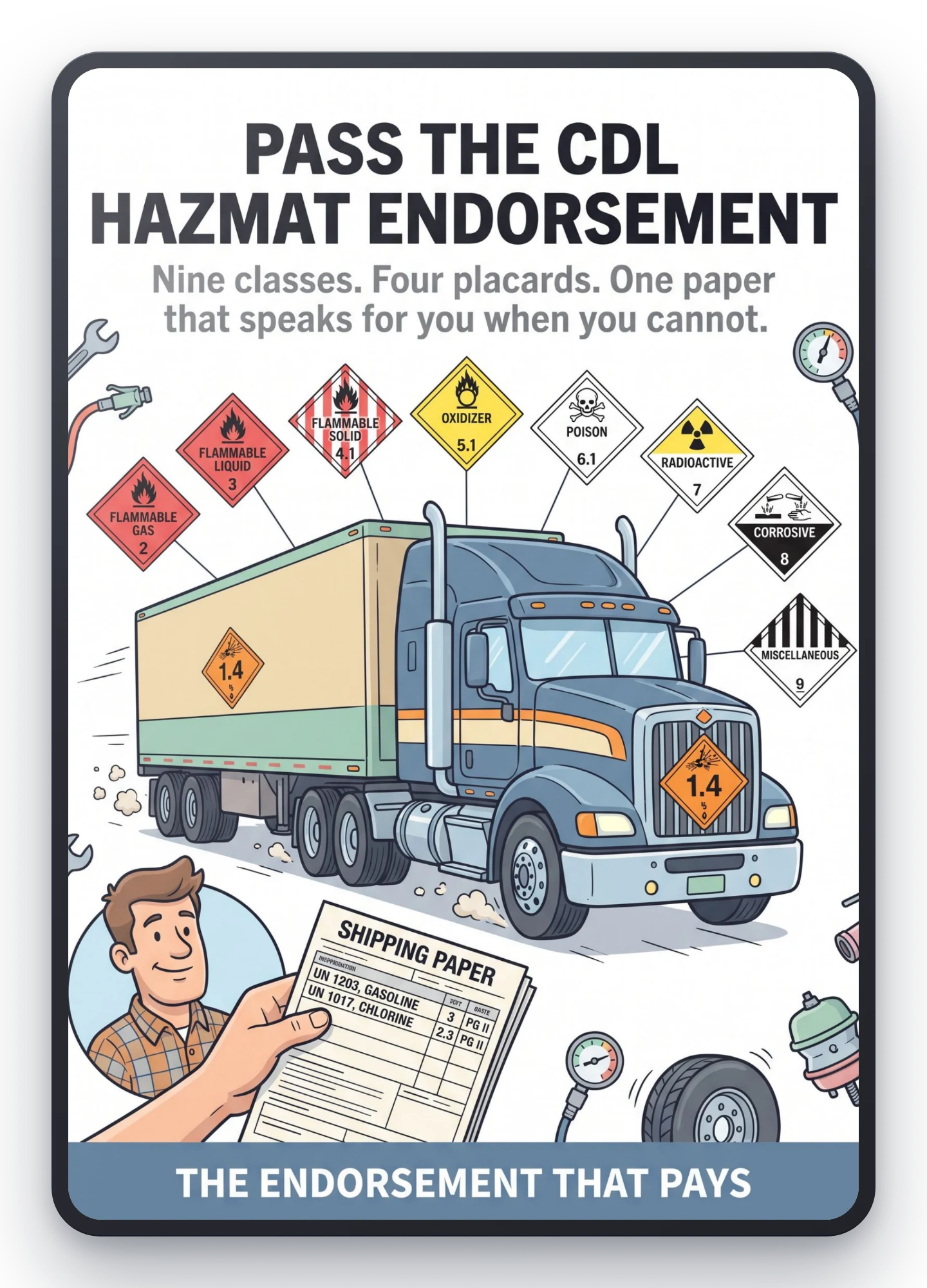
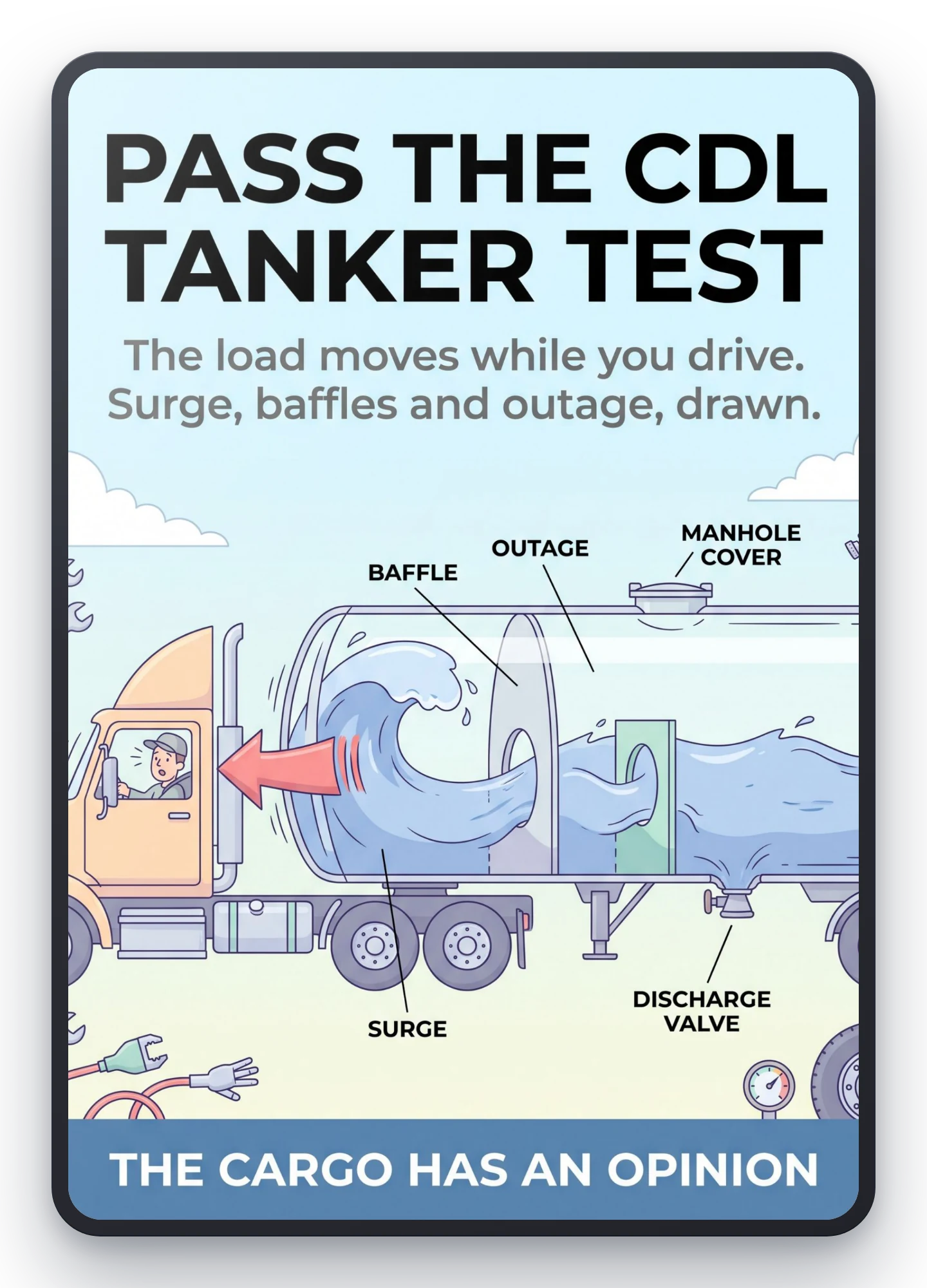
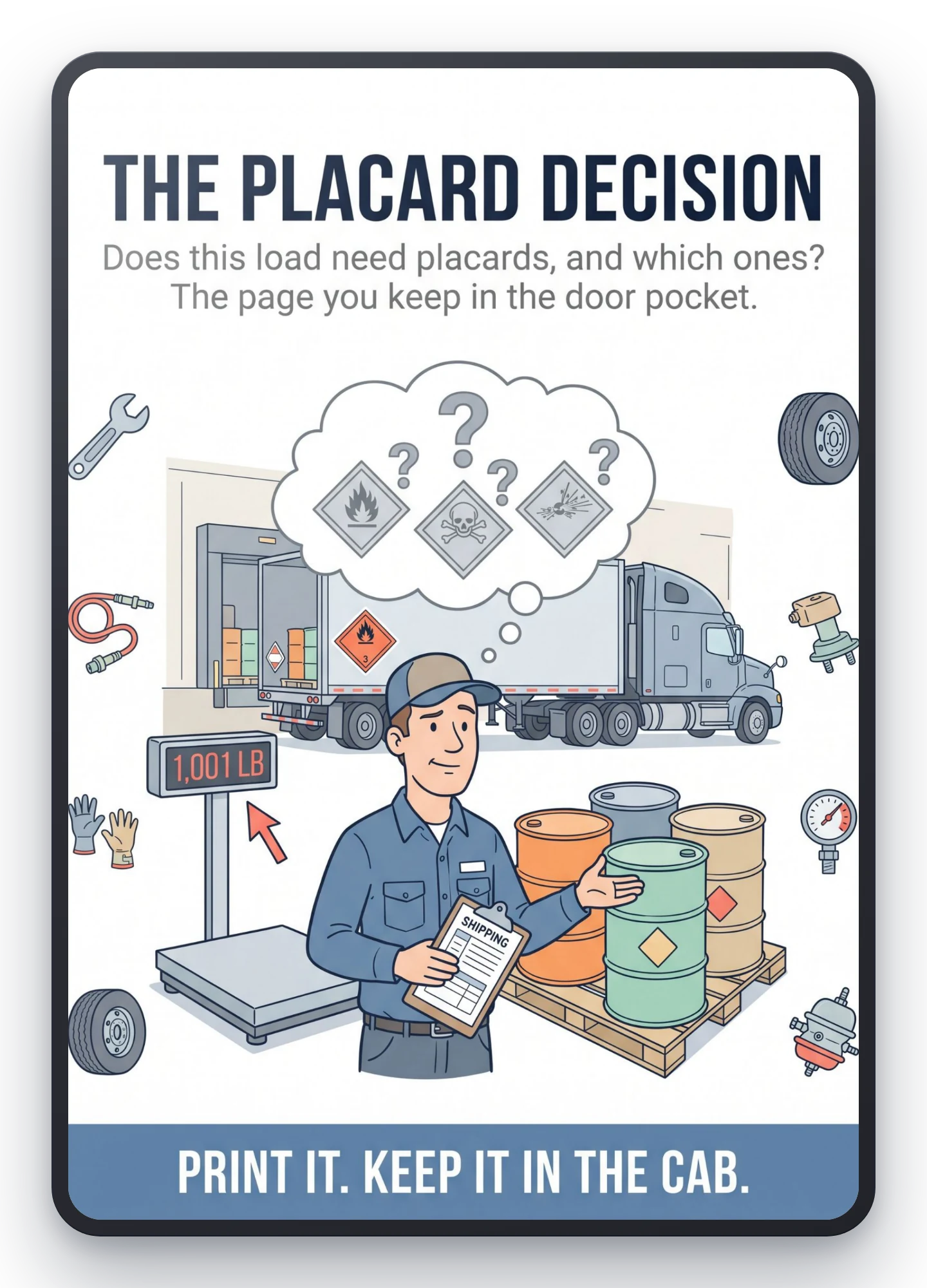
Hazmat is not harder than the other tests. It is just written in a language nobody ever draws for you. 36 illustrated pages, one idea each — plus the tanker test and the placard decision, free.
Not the manual chapter you already closed once. Tap any page to read it full size.
You opened section 9 of your state manual, read four pages about shipper responsibilities and closed it. That is not a discipline problem. It is forty pages of regulation prose with two tables buried in the middle of it.
And the test does not ask you to recite regulations. It asks you where you are in the trip and what applies right there: at the dock, loading, placarding, on the road, parked, at the scene of a leak.
So that is how this book is laid out. Nine classes you can see. One decision diagram for the placards. One page per rule, in the order you meet it between the shipper's door and the delivery.
The rules did not get easier.
They got drawn.
The book is the hazmat written test. The tanker test comes with it, free — hold both endorsements and you have the X.
36 pages. The nine classes, the shipping paper, the placard tables, loading, driving, parking and the emergency numbers — plus every figure on one sheet and a page to test yourself.
The load moves while you drive. Surge, baffles, outage and how much you can actually carry, drawn. The N endorsement, taken the same day as the H.
Does this load need placards, and which ones? One diagram, nine class cards and two tear-out sheets made to print and keep in the door pocket.
What the endorsement is worth, the fingerprints and the TSA check, and the three people the regulations talk about: shipper, carrier, driver.
Drawn one by one with their diamond, their colour and their symbol. Nine shapes you recognise instead of nine definitions you recite.
The shipping paper and its three names, where it has to be while you drive, the UN and NA numbers, and the Emergency Response Guidebook.
Table 1, table 2, the 1,001 pound line and the DANGEROUS placard. The part of the test that is really one decision, made three times.
What cannot travel together, cargo heaters, attending a tank, railroad crossings, parking with explosives and the routes you cannot take.
Your three jobs at the scene, CHEMTREC, a leak of poison gas — then every figure on one sheet and a blank page to test yourself.
You do not have to do it this way. But the written test is eight days of reading if you have a plan, and three weeks of avoiding it if you do not.
Part II. Nine diamonds, nine colours, nine symbols. After this the regulations stop being words and start being shapes.
The shipping paper, the ID number and the guidebook. Where it goes and why it has to be within reach when you are behind the wheel.
Table 1, then the weight, then how many classes. Run the diagram from the bonus book until you can do it without looking.
Segregation, heaters, tanks, crossings, parking and routes. Most questions are really «at this moment of the trip, what applies?»
Print the sheet with every figure on it, cover the right column and say them. If you can do that, you are ready for the written test.
You have the CDL and the miles. Hazmat is the endorsement that opens fuel, chemical and tank work, and the reason you do not have it yet is that section 9 is unreadable.
Hazmat and tanker are usually taken on the same day as the other written tests. Walk in with the nine classes already in your head instead of cramming them the night before.
Every class, every placard and every piece of paper is drawn next to its name, so you learn the word and the thing at the same time instead of translating a regulation.
Not a blog, not a practice app: the official manuals the test is written from, in California, Texas, Florida, New York and Ohio. Each figure was looked up, one by one, before the page was drawn.
Hazmat is the part of the CDL that travels best, because the rules are federal and the five manuals print the same text. The 1,001 pound line, the twenty-five feet you keep a placarded truck from an open fire, the thirty days CHEMTREC keeps your call on file — those are the same in every state, and that is why they could be printed as the answer.
Where something is not federal — the routes your state closes to placarded loads, the permits it asks for — the page says so and leaves you a space instead of inventing a number.
Your examiner's score sheet always wins.
The book says so on page three.
All three PDFs arrive by email within minutes. One payment, no subscription.
For 30 days. If a file does not open, if what you received is not what this page describes, if you were charged twice or the download never arrived, write to us and we refund you in full.
One email to info@studiofacilebook.com is enough.
It gets you through the written test, which is one of two things you need. The other is a TSA security threat assessment: fingerprints, a background check and a fee you pay to your state, and it takes weeks. No book can do that part for you. Page four explains exactly how it works and in what order to do the two things, so you do not lose a month waiting.
That is your call, not ours. What is true is that hazmat is the endorsement that most often comes with a higher rate per mile, because fewer drivers have it and because tank and fuel work is closed to you without it. It is also the one with the extra paperwork, which is precisely why fewer drivers have it.
Yes, that is bonus 1. Hazmat is the H endorsement and tanker is the N; hold both and you get the X, which is what most fuel and chemical jobs ask for. The two tests are usually taken on the same day.
Yes, and hazmat travels better than any other part of the CDL: the hazardous materials rules are federal, the same text in every state manual. Every figure in this book was still checked against the official handbooks of five states, one by one, before the page was drawn. Your examiner's score sheet always wins, and the book says so.
By email, straight after you buy. Three PDFs you can read on your phone at the dock or print and take with you.
Yes, as many times as you want, for yourself. The placard decision and the nine class cards are made to be printed and kept in the cab.
No. It does not give you a licence, an endorsement or a certificate, and it does not replace your training provider or your state's examiner. It is study material.
Hazmat is the endorsement that pays, and it is the one fewest drivers bother to get.
Not because the test is hard. Because the chapter is unreadable, and nobody ever drew it.
Nine classes.
One paper. Four placards.